Brass Rounds
Brass Round Bar Grades and Applications
Our brass round bars are available in standard and precision-ground forms for applications requiring reliable machinability, corrosion resistance, and electrical conductivity. Supplied in multiple grades, diameters, and cut lengths, these copper-zinc alloy bars support precision machining, plumbing, electrical connectors, automotive components, aerospace parts, and architectural hardware.
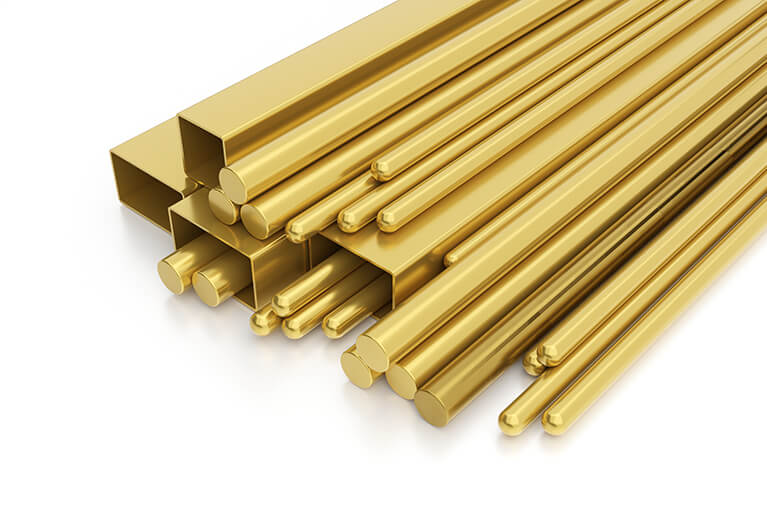
Common Brass Round Bar Grades:
- C360 (Free-Machining Brass): High machinability, corrosion resistance, and strength, making it ideal for precision components.
- C464 (Naval Brass): High corrosion resistance, particularly in marine environments.
- C260 (Cartridge Brass): Good ductility and strength, commonly used in ammunition casings and decorative applications.

Applications:
- Precision machining
- Plumbing and fittings
- Automotive and aerospace parts
- Electrical connectors and terminals
- Decorative and architectural elements
Precision Ground Brass Bars
Our precision ground brass bars are centerless ground to tight dimensional tolerances for consistent diameter, straightness, and a smooth surface finish. Their excellent machinability, corrosion resistance, and dimensional accuracy make them suitable for bearings, shafts, bushings, valves, fittings, and other high-precision components.

Key Features:
- Tight dimensional tolerances: Ensures consistent sizing for precise applications.
- Smooth surface finish: Reduces friction and improves aesthetics.
- Superior straightness: Ideal for shafts and linear motion systems.

Common Uses:
- Precision instruments
- Hydraulic and pneumatic systems
- Aerospace and medical components
- High-performance mechanical assemblies
Brass rounds (cylindrical brass stock) come in various grades, each with different compositions and properties suited for specific applications. Here are some of the most common brass grades used for rounds:
Available Brass Grades for Precision Ground Round Bars
C260 (Cartridge Brass)
- Composition: ~70% Copper, ~30% Zinc
- Properties: High strength, good corrosion resistance, excellent cold working properties
- Uses: Ammunition casings, plumbing fittings, automotive radiator cores, fasteners
C360 (Free Machining Brass)
- Composition: ~61.5% Copper, ~35.5% Zinc, ~3% Lead
- Properties: Excellent machinability, good corrosion resistance, moderate strength
- Uses: Precision components, valves, fittings, and fasteners
C464 (Naval Brass)
- Composition: ~60% Copper, ~39% Zinc, ~1% Tin
- Properties: High corrosion resistance (especially in marine environments), strong and durable
- Uses: Marine hardware, propellers, shipbuilding components, heat exchangers
C220 (Commercial Bronze)
- Composition: ~90% Copper, ~10% Zinc
- Properties: Good strength, corrosion resistance, and a reddish-gold color
- Uses: Decorative applications, jewelry, medallions, and light mechanical parts
C230 (Red Brass)
- Composition: ~85% Copper, ~15% Zinc
- Properties: Strong corrosion resistance, good machinability, and good forming properties
- Uses: Plumbing pipes, electrical connectors, and musical instruments
C280 (Muntz Metal)
- Composition: ~60% Copper, ~40% Zinc
- Properties: High corrosion resistance, stronger than pure brass
- Uses: Architectural trim, marine applications, industrial machinery
C385 (Architectural Bronze)
- Composition: ~57% Copper, ~40% Zinc, ~3% Lead
- Properties: Excellent machinability, high strength, good corrosion resistance
- Uses: Architectural hardware, decorative elements, and structural applications
Choosing the Right Brass Grade
- If you need excellent machinability: C360
- If you need high corrosion resistance (marine use): C464
- If you need high strength and cold workability: C260
- If you need an aesthetically pleasing alloy: C220 or C230
- If you need a mix of machinability and corrosion resistance: C385