Alloy Steel vs Carbon Steel: Which Is Right for Your Precision Parts?
April 17, 2026
Tool Steel O1 vs A2 vs D2: Which Grade Should You Pick for Your Die?
April 17, 2026
Choosing the wrong stainless steel grade costs you time, money, and parts. Both 304 and 316 are austenitic stainless steels, and they look identical on a shelf. But their performance in corrosive environments is very different. Knowing which one fits your application protects your equipment and your budget.
We’ve supplied precision-ground stainless steel round bars from Chicago, Illinois, for over 30 years. Precision in Every Shape & Size, Your Round Bar Experts, is not just a tagline for us. It’s how engineers, buyers, and procurement managers across the Chicago area have come to rely on us. This guide gives you a clear, practical answer so you can specify the right grade with confidence before your next order.
304 vs 316: The Differences That Actually Matter in the Field
The biggest difference between these two grades is molybdenum. Grade 316 contains it. Grade 304 does not. That single addition gives 316 a stronger defense against chlorides, saltwater, and harsh chemicals. In a controlled indoor environment, you won’t notice the gap. In aggressive service, that gap becomes a very real maintenance problem.
Getting the grade selection right at the start saves you from early part failure, unplanned downtime, and replacement costs. Both grades machine well and both hold the tight tolerances our centerless grinding achieves. The decision should come down to your service environment, not grindability or machinability.
When 304 Is the Right Grade for Your Application
304 and 304L are the most widely used stainless grades for good reason. They perform reliably in food processing equipment, architectural hardware, indoor industrial assemblies, and general CNC machining work. If your parts stay in a controlled environment with only mild moisture or cleaning agents, 304 handles the job cleanly and consistently.
Our centerless ground 304 bars hold h6, h7, and h8 tolerance classes with surface finishes of Ra ≤ 0.2 to 0.8 µm. For Swiss machine shops, incoming bar consistency is critical because dimensional variation in the stock compounds through every cut. Specify 304L when welding is involved, as the low carbon content protects corrosion resistance through the weld zone.
When 316 Is the Grade You Actually Need
Once chlorides enter the picture, 316 becomes the right answer. Marine hardware, medical instruments, chemical processing lines, and saltwater pump systems are where 304 starts to show pitting over time and 316 holds up. The molybdenum in 316 actively resists that pitting and crevice corrosion in ways 304 simply cannot match.
We supply Pump Shaft Quality Bars for demanding fluid service environments, and 316 is almost always the grade that follows that conversation. Specify 316L rather than standard 316 when your assembly includes welded joints, so corrosion resistance stays intact through the heat-affected zone and not just in the base material.
Other Stainless Grades We Supply
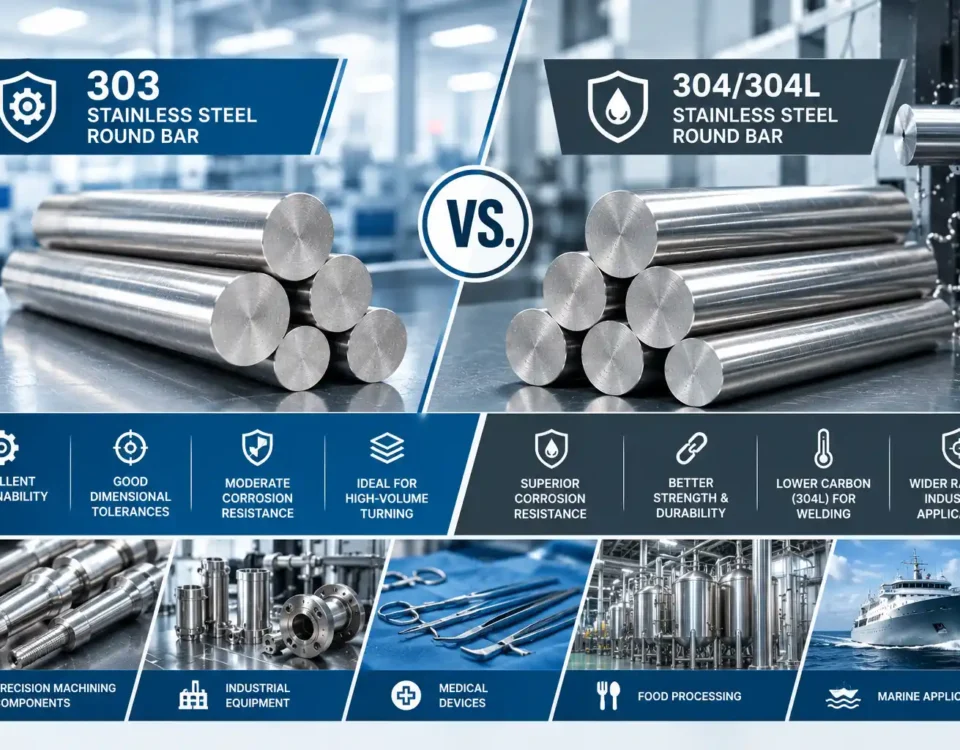
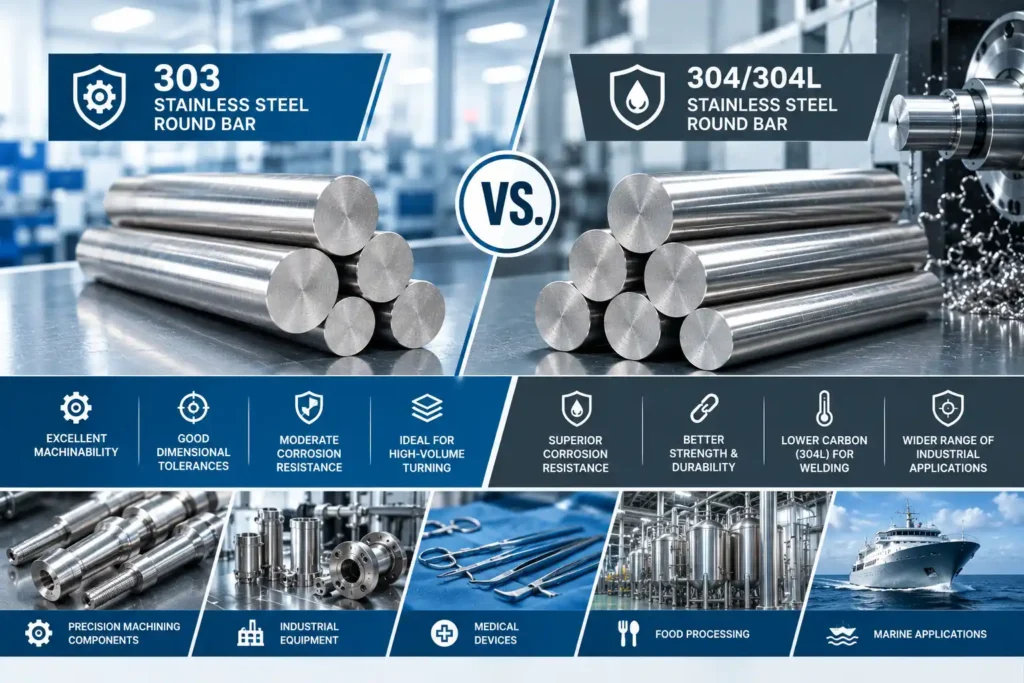
Beyond 304 and 316, we stock a full range of precision-ground stainless grades. For high-volume machining where machinability is the priority, 303 is available. For elevated temperature service, 321 and 310/310S are the right direction. Where both high strength and corrosion resistance are required together, 17-4 PH is a strong option used regularly in aerospace and medical applications.
For maximum hardness in bearings, blades, and precision tooling, 440C carries the highest hardness among the stainless grades we carry. For structural or offshore environments, we supply 2205 Duplex and 2507 Super Duplex. All grades are available as precision-ground round bars, most are domestically sourced, and all comply with DFARS, REACH, and RoHS requirements.
Get the Right Stainless Bar Spec for Your Next Order
Specifying the right grade is only half the job. Getting it ground to the exact tolerance your application demands is the other half. We hold h6, h7, and h8 tolerance classes with surface finishes of Ra ≤ 0.2 to 0.8 µm on every stainless bar we ship. That level of precision is what keeps your shafts, bearings, and linear motion components running the way they should.
Submit a quote at precisiongroundmetals.com, email us at sales@precisiongroundmetals.com, or call (708) 400-7217. We are available Monday through Friday, 7 AM to 5 PM and Sundays, 7 AM to 5 PM. Tell us your grade, diameter, tolerance class, and application, and we’ll take it from there.
FAQs
What is the main difference between 304 and 316 stainless steel?
316 contains molybdenum, giving it stronger resistance to chlorides and saltwater. 304 suits general-purpose, food-grade, and indoor industrial applications where corrosion demands are moderate.
When should I specify the L variant of either grade?
Choose 304L or 316L when your parts will be welded. Low carbon content keeps corrosion resistance intact through the weld zone and heat-affected area.
What tolerances do your precision-ground stainless bars hold?
Our centerless ground stainless bars hold h6, h7, and h8 tolerance classes with surface finishes of Ra ≤ 0.2 to 0.8 µm, suitable for shafts and bearing applications.
Do you carry stainless grades beyond 304 and 316?
Yes. We stock 303, 321, 310/310S, 410, 420, 440C, 17-4 PH, 2205 Duplex, and 2507 Super Duplex as precision-ground round bars.