What Does DFARS Compliant Steel Mean for Your Manufacturing Project?
April 21, 2026
Which Stainless Steel Grade Is Best for CNC Precision Machining?
April 27, 2026
Hydraulic and pneumatic shafts are precision surfaces, not just structural bars. Seals run against them under load thousands of times. The wrong grade causes early seal wear, leaks, and downtime. Getting the material right from the start saves you that cost.
At Precision Ground Metals, Inc. in Chicago, IL, we’ve helped engineers and buyers specify shaft-quality bar stock for over 30 years. The right grade depends on your load, your environment, and the finishing standard your seals require.
Choosing the Right Steel Grade for Your Shaft Application
Every hydraulic and pneumatic shaft needs two things: a grade matched to its environment and a finishing standard matched to its seal requirements. Choosing one without the other leads to problems on the floor, not just on paper.
The grades and finishing standards we carry exist specifically for these applications. Whether your concern is corrosion, fatigue, or dimensional consistency, there’s a verified answer in our lineup for what your system actually needs.
4140 Alloy Steel: The Go-To Grade for General Industrial Systems
4140 is what most engineers specify first for hydraulic and pneumatic shafts in clean indoor environments. We carry it precision ground to tolerances of plus or minus 0.0005 inches or better. It handles cyclic loading well and machines cleanly for secondary operations.
Its limitation is corrosion. Any moisture or chemical contact degrades the surface fast, and a damaged shaft surface destroys seal life. If your system runs wet or near chemicals, 4140 isn’t the right answer.
4340 Alloy Steel: Built for Higher Loads and Fatigue Demands
When pressure loads or shock conditions push beyond what 4140 handles, 4340 is the stronger choice. It delivers greater toughness and fatigue resistance while holding the same precision ground tolerances we carry across our alloy steel lineup.
Like 4140, it belongs in protected or lubricated environments only. It’s not a corrosion-resistant grade. Where it earns its place is in heavy-duty hydraulic assemblies, where shaft fatigue and load margins are the primary engineering concern.
316 Stainless Steel: The Corrosion-First Answer
For shafts running in food processing facilities, pharmaceutical plants, marine installations, or anywhere aggressive fluids are present, 316 is the grade we recommend most. We supply it precision ground in h6, h7, and h8 tolerance classes with surface finishes achieved through centerless grinding.
We also carry 316 as Pump Shaft Quality stock, a finishing standard built specifically for demanding environments where corrosion resistance can’t be compromised. If the environment is the primary threat to your shaft, this is where the conversation starts.
303 Stainless Steel: Machinability Without Giving Up Protection
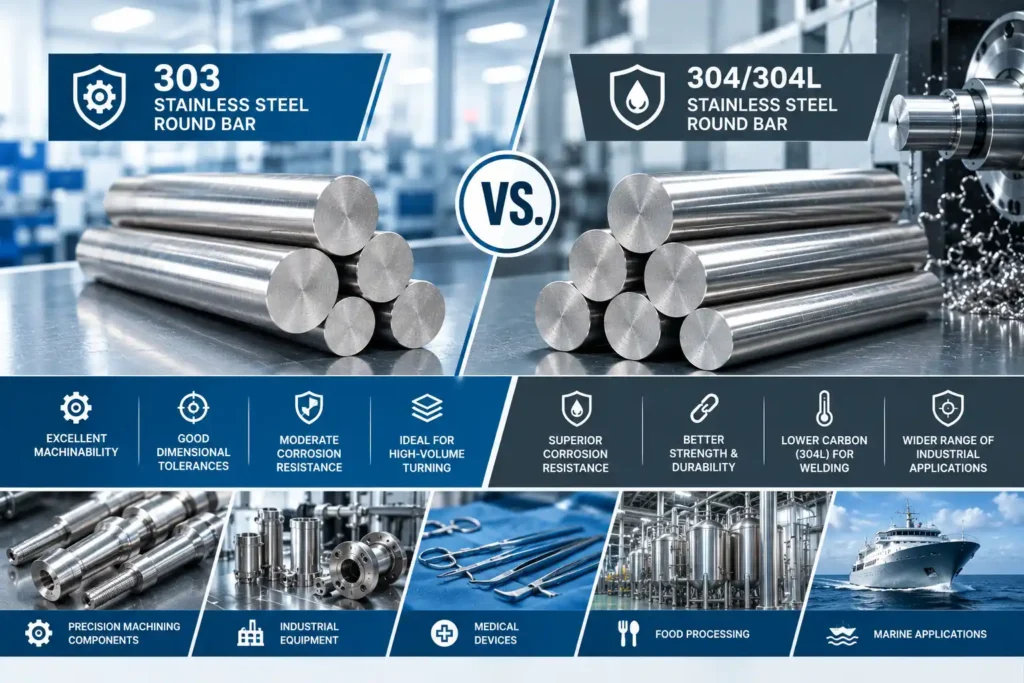
303 is the free-machining stainless grade in our lineup. It gives your shop better tool life and cleaner chip control during secondary operations compared to 316. For pneumatic shafts in clean industrial environments with moderate exposure, it’s a practical and cost-effective stainless option.
The tradeoff is that 303 doesn’t match 316 in aggressive or chloride-heavy environments. Use it where machinability is a priority, and the environmental conditions are manageable, not where corrosion resistance is the deciding factor.
17-4 PH Stainless Steel: When Strength and Corrosion Resistance Both Matter
Some shaft applications demand high strength and corrosion resistance together. 17-4 PH is the precipitation hardening grade in our stainless lineup that delivers both. It fits aerospace actuators, defense hydraulics, and high-performance industrial systems where standard austenitic grades can’t meet both demands at once.
Standard grades like 304 and 316 can’t match its strength levels. When your load requirements and environmental conditions both push the limits at the same time, 17-4 PH is the grade worth specifying.
Finishing Standards That Make Every Grade Perform
The grade alone doesn’t build a shaft that works in service. Our turned, Ground and Polished bars improve dimensional accuracy and surface quality together. Seal performance depends on consistent diameter across the full working length of the shaft, and TGP delivers that.
We also offer straightening to eliminate bow, chamfering for burr-free ends that protect seals during assembly, and custom cut lengths so you receive exactly what your build requires. Protective packaging keeps the finish intact during shipping.
Get the Right Bar Stock for Your Next Shaft Application
We stock 4140, 4340, 316, 303, and 17-4 PH as precision ground bar in the finishing standards that hydraulic and pneumatic builders actually specify. Our team is ready to help you match the grade and finish to your application requirements.
Call us at (708) 400-7217, email sales@precisiongroundmetals.com, or submit a quote request at precisiongroundmetals.com/request-a-quote. We respond fast, and we know these materials.
FAQs
Which stainless grade works best for corrosive hydraulic environments?
316 and 316L are our first recommendation. We carry both as precision-ground bar and as Pump Shaft Quality stock for demanding environments.
What is the difference between Pump Shaft Quality and Bearing Shaft Quality?
Pump Shaft Quality is finished for corrosion resistance in demanding environments. Bearing Shaft Quality is finished for wear resistance in linear motion applications. Your environment decides what you need.
Can you supply custom-cut lengths for shaft orders?
Yes. We offer cutting to custom lengths, chamfering of bar ends, and protective packaging to preserve the surface finish during transit.
Is 4140 suitable for pneumatic shaft applications?
4140 works well in clean indoor systems. For applications with moisture or chemical exposure, a stainless grade is the better long-term choice.