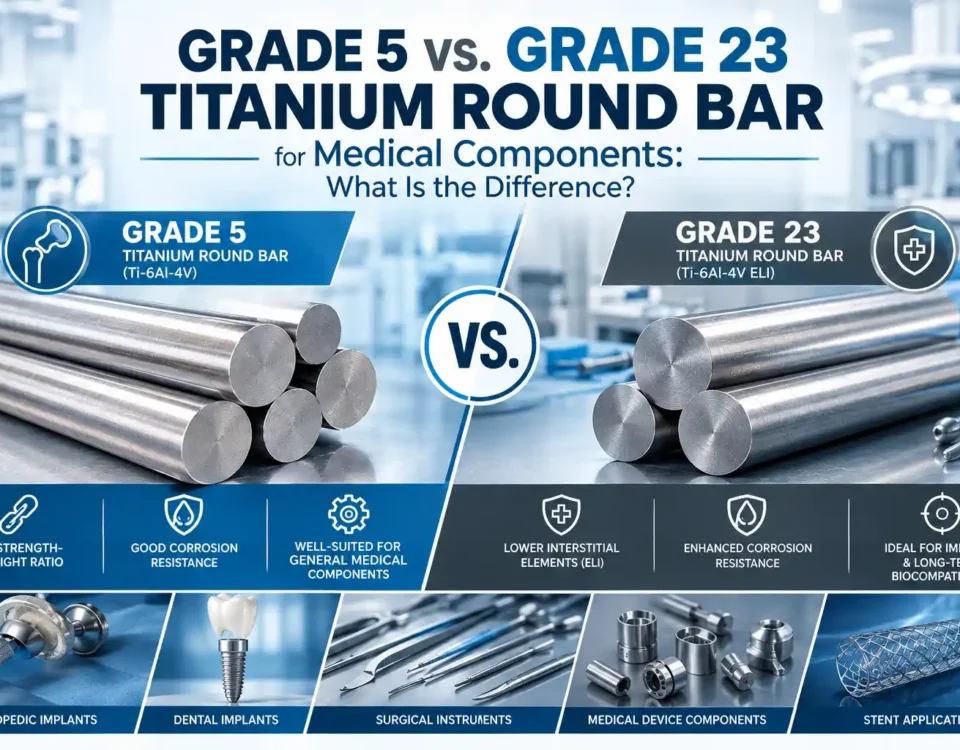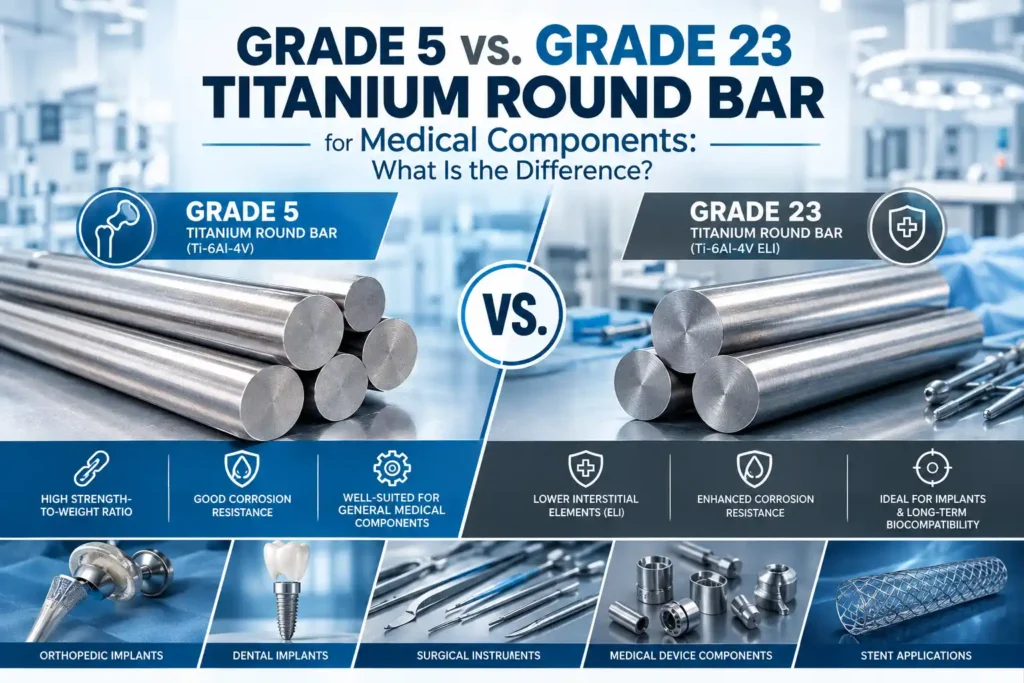
Grade 5 vs. Grade 23 Titanium Round Bar for Medical Components: What Is the Difference?
September 21, 2026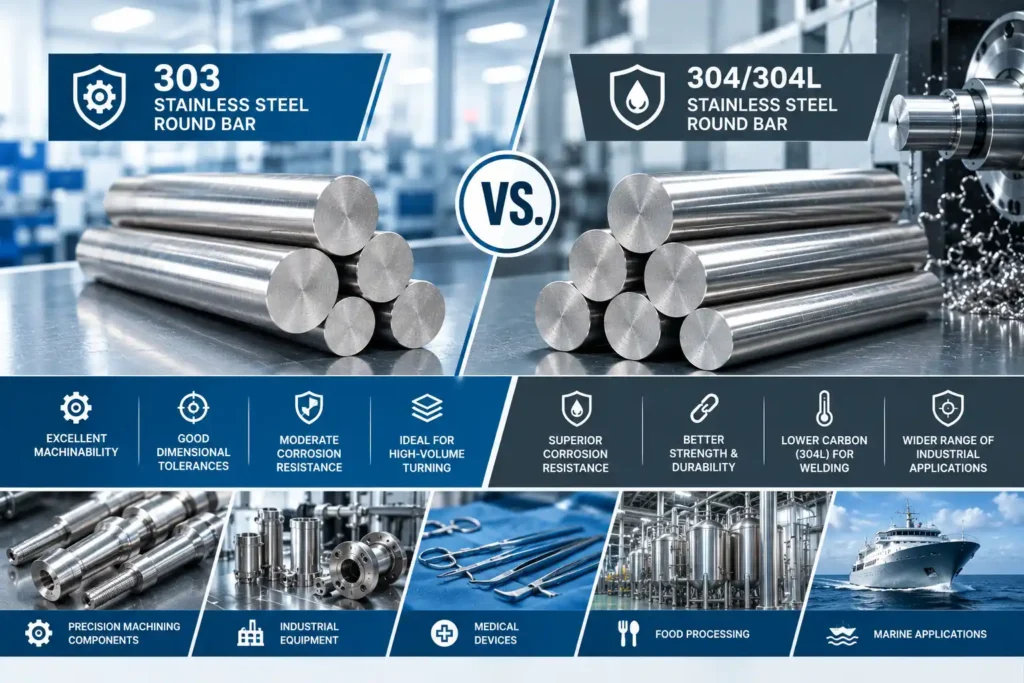
At Precision Ground Metals, Inc., we treat the choice between 303 and 304/304L stainless steel round bar as a production decision. The short answer is conditional: we would review 303 stainless steel round bar first when excellent machinability is the main requirement and the corrosion resistance fits the part. We would review 304/304L stainless steel round bar first when the project places greater weight on corrosion resistance, weldability, and general-purpose industrial performance identified on our stainless steel precision ground bars page.
We also review diameter, tolerance, straightness, surface finish, component function, service environment, inspection needs, quantity, and downstream operations so the grade choice connects to your turning process.
303 vs. 304/304L: our practical grade comparison
Our material information describes 303 as a free-machining stainless steel with excellent machinability and corrosion resistance for precision-machined components. It describes 304/304L as a general-purpose stainless steel grade with outstanding corrosion resistance and weldability for industrial applications. We use those verified attributes to establish the first review, not to declare a universal winner.
When we review 303 stainless steel round bar
We review 303 when machinability carries significant weight and the part still needs corrosion resistance. The free-machining description makes it relevant to repeated turning of precision-machined components. We ask you to describe moisture, process fluids, cleaning agents, chemical contact, and storage because “corrosion resistant” does not define every service environment.
When we review 304/304L stainless steel round bar
We review 304/304L when corrosion resistance, weldability, and general-purpose stainless performance are more important to the application. Our page identifies 304/304L for general-purpose industrial applications, making it a logical review grade when the component needs broader corrosion performance rather than prioritizing maximum machinability. We compare it against your tooling, workholding, cutting sequence, geometry, and inspection plan, without promising a specific cycle time or tool life.
What high-volume precision turning requires
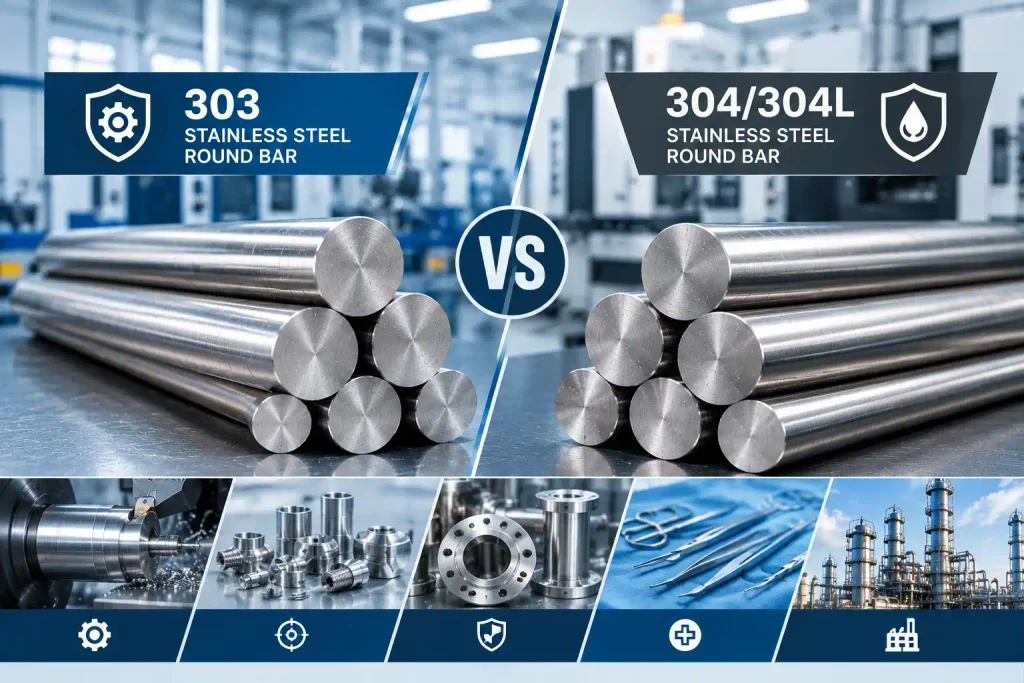
High-volume production makes the incoming bar specification more important. Repeated setups need clear material identity and dimensional characteristics. We choose the grade, define the precision-ground bar requirements, and confirm inspection and preparation as separate decisions for purchasing, machining, and quality.
Machinability and process fit
Both grades can be considered for precision machining, but 303 is specifically described as a free-machining grade, while 304/304L is positioned as a general-purpose stainless grade with outstanding corrosion resistance and weldability. We use that difference to frame the discussion. Your equipment, tooling, cutting data, workholding, and geometry determine the actual result.
For a repeat program, we document the grade on the purchase order and connect it to the drawing and lot information. If you need technical confirmation before placing a larger order, include the turning priorities in our Request a Quote message.
Corrosion and component function
We use the corrosion descriptions as an application filter. A production environment where machinability leads may support an initial 303 review. A project where corrosion resistance and broader general-purpose stainless performance carry more weight may move 304/304L higher in the review. We also consider whether the bar becomes a shaft, bearing-related part, linear-motion component, tooling element, or another precision-machined component.
Our stainless steel page identifies shafts, bearings, linear-motion components, medical instruments, aerospace and defense, and precision machining or tooling. We use those signals to ask better questions, not to assume that every grade suits every part.
Do not confuse grade with bar specification
Choosing 303 or 304/304L does not automatically deliver the dimensional result your turning operation needs. We describe precision-ground stainless bars as centerless-ground products with controlled tolerances, surface finishes, and straightness. We still need your drawing to identify the exact requirement.
Diameter, tolerance, and cut length
We start with the nominal incoming diameter and the turning allowance. Our stainless steel information gives h6, h7, and h8 as examples of tolerance classes that may be considered according to engineering requirements. We do not assign one without the drawing.
State whether the dimension is the incoming ground-bar size or final turned size, and whether fixed cut lengths are needed before turning.
Straightness, runout, and surface finish
Our page identifies excellent straightness and minimal runout as relevant to shafts, linear-motion components, bearings, and CNC components. If your drawing includes a straightness or runout requirement, we list it separately from diameter tolerance.
Our page also lists centerless-ground surface finishes of Ra ≤ 0.2-0.8 μm, depending on engineering requirements. We ask you to state the required Ra value and whether later polishing or finishing changes the incoming requirement.
Hardness and strength
Hardness and strength can vary by stainless grade and heat treatment. If either property matters to turning, assembly, or service, we ask you to include the exact requirement and request confirmation of the available material condition. A machinability comparison is not a complete mechanical-property specification.
How centerless grinding supports the decision
Centerless grinding provides a controlled dimensional and surface starting point. Our process information can include cold drawing, grinding, polishing, inspection, and testing. We connect each process to a measurable output such as diameter, tolerance, straightness, or surface finish.
We state that precision-ground stainless steel bars undergo dimensional inspection and quality testing before shipment. We ask you to identify project-specific inspection, documentation, packaging, or shipping needs in the RFQ.
What we include in the RFQ
Send the drawing or written specification with the exact grade, incoming diameter, tolerance, straightness, surface finish, cut length, quantity, end use, machining priority, corrosion environment, and inspection requirements. Add any cutting, straightening, chamfering, finishing, packaging, shipping, hardness, strength, condition, compliance, or documentation needs through Request a Quote.
Final decision
Our answer is conditional. We would review 303 stainless steel round bar first when excellent machinability is the leading requirement and the corrosion resistance fits the environment. We would review 304/304L stainless steel round bar first when corrosion resistance, weldability, and general-purpose stainless performance are more important to the application.
We would not approve either grade from the title alone. We would confirm part function, environment, diameter, tolerance, straightness, finish, hardness or strength needs, inspection requirements, and downstream operations. Start with our stainless steel precision ground bars page, then send the drawing, grade preference, dimensions, quantity, and application through Request a Quote.
FAQs
Is 303 always better for high-volume turning?
No. We choose 303 when machinability is a leading requirement, while 304/304L may be preferred when corrosion resistance, weldability, and general-purpose stainless performance carry more weight.
When should you consider 304/304L?
We consider 304/304L when corrosion resistance, weldability, and general-purpose industrial performance are important to the application.
When should you consider 303?
We consider 303 when excellent machinability and corrosion resistance are important for a precision-machined component.
Does the grade determine tolerance?
No. We specify grade, diameter, tolerance, straightness, and finish separately.
What should you send with a quote request?
Send the grade, dimensions, tolerance, finish, quantity, environment, inspection needs, and drawing through Request a Quote.