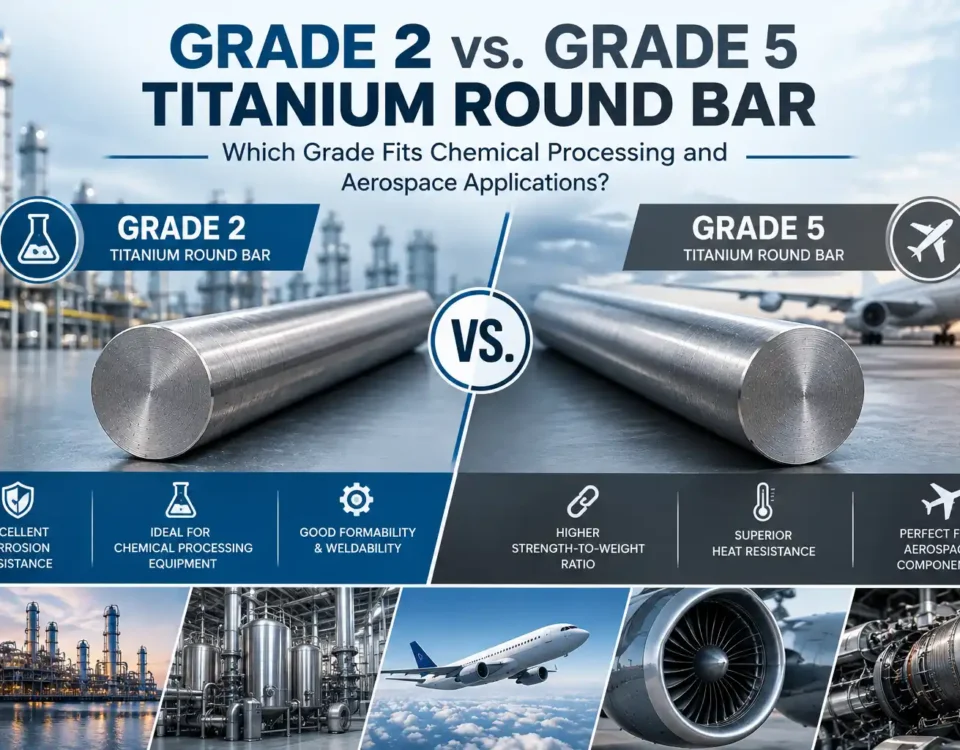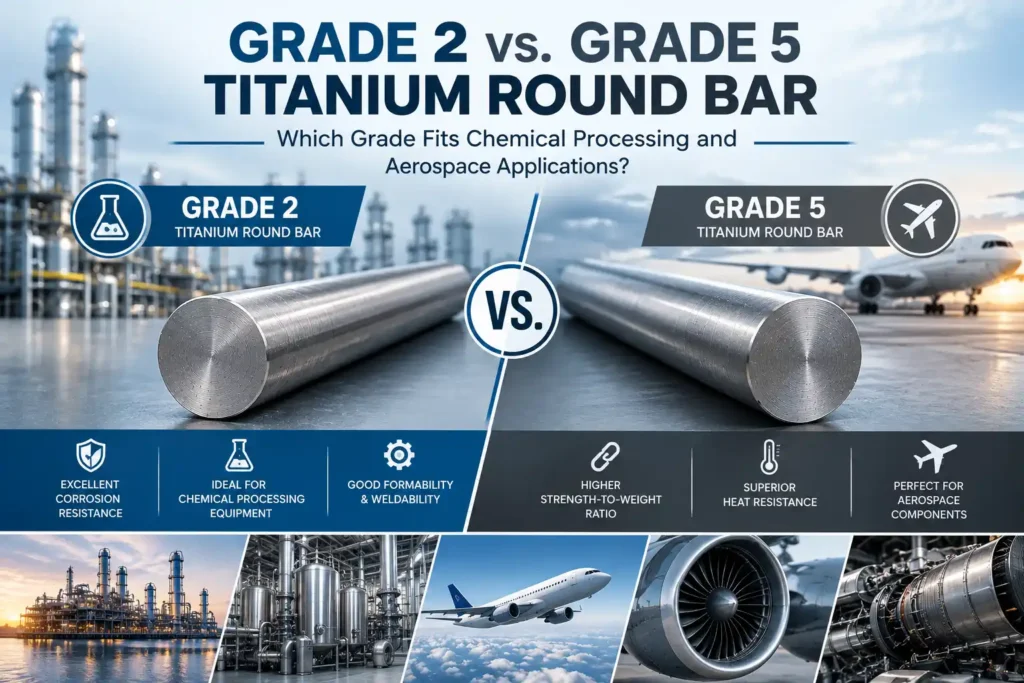

Grade 2 vs. Grade 5 Titanium Round Bar: Which Grade Fits Chemical Processing and Aerospace Applications?
September 19, 2026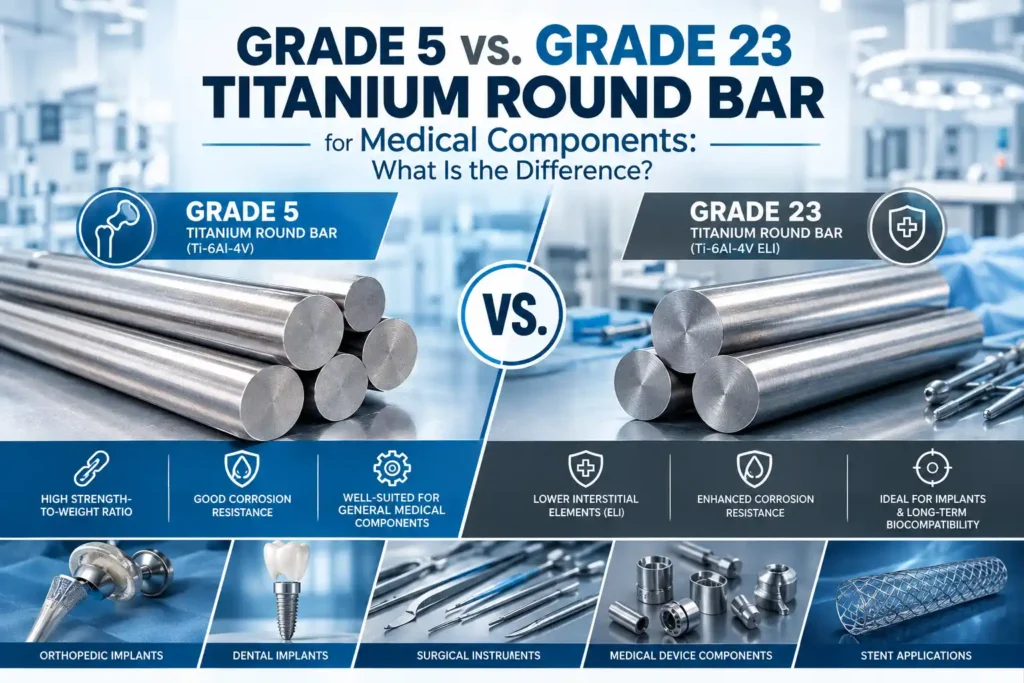
At Precision Ground Metals, Inc., we compare Grade 5 vs. Grade 23 titanium round bar by separating general medical-component needs from implant-specific requirements. For medical and other applications, we review Grade 5 as Ti-6Al-4V when you need high strength, corrosion resistance, and good weldability. For implant-related applications, we also review Grade 23 as Ti-6Al-4V ELI, an extra-low interstitial version of Grade 5 with improved toughness and biocompatibility for medical implants.
Our practical starting point is simple. We review Grade 5 when a medical component needs high strength, corrosion resistance, and good weldability. We review Grade 23 when improved toughness and biocompatibility are central, especially for implant-related work. We still need the drawing, component function, service conditions, dimensions, condition, inspection plan, and documentation requirements before confirming the bar.
Grade 5 and Grade 23: the key difference
We work with both grades as Ti-6Al-4V titanium alloys, but the right choice depends on your component requirements. We consider Grade 5 when your application calls for the combination of high strength, corrosion resistance, and good weldability. We work with Grade 5 across applications including aerospace, medical, and automotive components. For medical implant applications, we consider Grade 23, the extra-low interstitial version of Grade 5, when improved toughness and biocompatibility are important requirements.
When we review Grade 5
We review Grade 5 for medical components where high strength and corrosion resistance are important and the part does not require the specific Grade 23 implant-focused description. The good-weldability attribute also matters when the design includes a qualified joining process. We still ask what the component does, how it is assembled, and which mechanical or surface requirements appear on the drawing.
Grade 5 may fit a broad medical manufacturing context, but we do not use the word “medical” as an automatic approval. We confirm whether the part is an instrument, device component, machined hardware, or implant-related item, then route the exact requirement through the quote process.
When we review Grade 23
We review Grade 23 when improved toughness and biocompatibility are central to the medical application. For implant-related projects, we give Grade 23 early consideration because its improved toughness and biocompatibility can be important to the application. We still ask for the design, surface, dimensional, inspection, and documentation requirements.
We do not treat Grade 23 as a universal replacement for Grade 5. If the project needs the broader Grade 5 combination of high strength, corrosion resistance, and good weldability without the implant-focused requirement, we review Grade 5 as well.
Define the medical component before choosing the grade
We first identify the component function, contact conditions, assembly method, load, and expected service environment. A surgical instrument, machined device component, and implant can have different priorities even when all are called medical products. We also ask what cleaning, sterilization, packaging, or inspection conditions your quality plan requires.
When we evaluate titanium for medical applications, we consider biocompatibility alongside the component’s function, service conditions, and other specified requirements. We use that information to establish the context, then keep the decision tied to the exact grade and component described in your request.
Precision-ground titanium bar requirements
Grade selection and bar preparation are separate decisions. We state the nominal diameter, tolerance, straightness, surface finish, cut length, quantity, material condition, and inspection needs. If the bar becomes a machined implant or medical component, each attribute must connect to the drawing and assembly process.

Diameter and dimensional control
We ask whether the requested diameter is the incoming precision-ground size or the finished machined size. We also ask whether cut blanks are needed before machining. This keeps the quote aligned with the raw bar requirement and avoids confusing a finished dimension with the incoming stock size.
Straightness and surface finish
Straightness can influence workholding and alignment. Surface finish can influence machining, contact, cleaning, and assembly. We treat straightness and surface finish as separate requirements from diameter tolerance and ask your team to provide the required limits and inspection method.
Toughness, strength, and condition
If the design relies on Grade 5 strength or Grade 23 toughness, we ask for the exact requirement and available material condition. We do not convert the general grade descriptions into a guaranteed mechanical result without a project-specific review.
Inspection and documentation questions
Medical sourcing often requires more than a grade name. We ask you to identify inspection points, lot or heat identification, dimensional records, documentation, packaging, and any customer quality language. We can then confirm what applies to the requested titanium bar.
We also ask whether cutting, chamfering, finishing, polishing, packaging, or shipping support is required. Stating each service and measurable output helps us review the order as a complete manufacturing request.
What we include in an RFQ
We send the exact grade, component type, drawing, diameter, tolerance, straightness, surface finish, cut length, quantity, material condition, toughness or strength requirement, inspection needs, and documentation language. For implant-related work, we clearly identify that context so Grade 23 can be reviewed against the stated biocompatibility and toughness needs.
Use our Request a Quote path to submit the requirements. You can also review the broader materials selection when your engineering team is comparing titanium with another material family.
Final decision
We review Grade 5 titanium round bar for medical components requiring high strength, corrosion resistance, and good weldability. We review Grade 23 titanium round bar when improved toughness and biocompatibility are central, particularly for medical implants. The drawing, component function, condition, dimensions, inspection plan, and documentation requirements determine the final choice.
FAQs
What is Grade 23 titanium?
Grade 23 is Ti-6Al-4V ELI. We consider it for medical implant applications where improved toughness and biocompatibility are important requirements.
Is Grade 23 the same as Grade 5?
It is an extra-low interstitial version of Grade 5, and we consider its improved toughness and biocompatibility when reviewing it for medical applications.
When should you review Grade 5?
We review Grade 5 for high strength, corrosion resistance, and good weldability in medical components.
When should you review Grade 23?
We review Grade 23 when implant-related toughness and biocompatibility are central requirements.
What bar details should you provide?
Send grade, diameter, tolerance, finish, straightness, cut length, condition, quantity, drawing, and inspection needs.
How do you request confirmation?
Send the medical application and drawing through Request a Quote for technical review.