
When Should You Specify C145 Tellurium Copper Round Bar for Machined Electrical Components?
September 17, 2026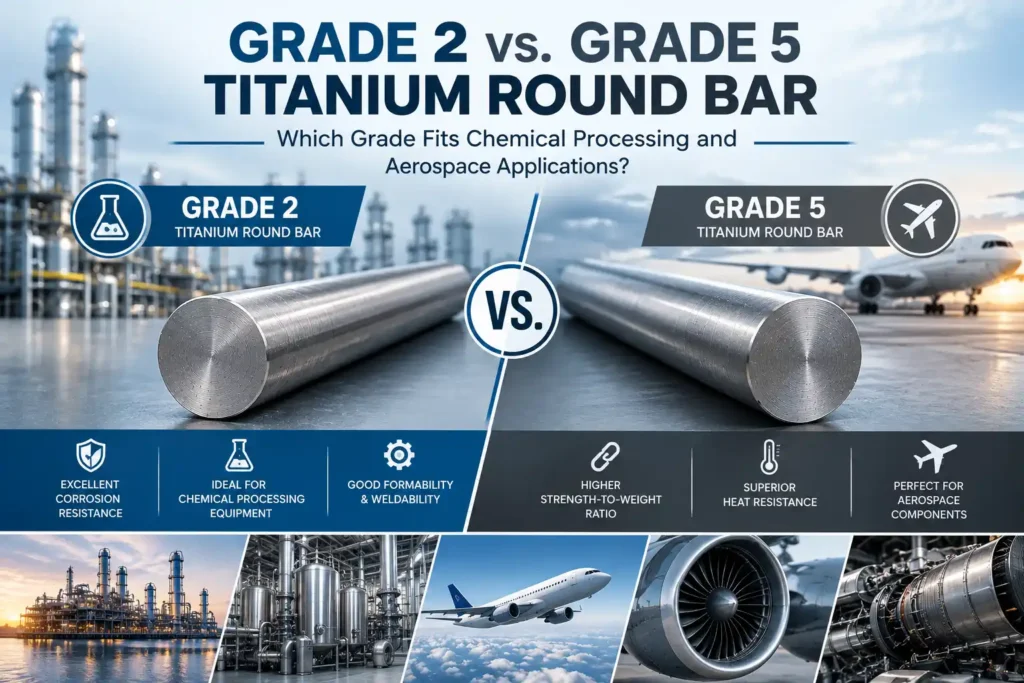
At Precision Ground Metals, Inc., we compare Grade 2 vs. Grade 5 titanium round bar by starting with the application’s dominant requirement. We review Grade 2 first when a project needs a balance of strength, ductility, and corrosion resistance. We review Grade 5 first when higher strength, corrosion resistance, and good weldability are central, especially for aerospace-related work. Grade 2 and Grade 5 serve different application priorities. Grade 2 is commonly considered when a balance of strength, ductility, and corrosion resistance is important, while Grade 5 is considered when higher strength, corrosion resistance, and good weldability are central to the application, particularly in aerospace.
The grade does not complete the specification. We also confirm diameter, tolerance, straightness, surface finish, cut length, quantity, heat or strength requirements, and inspection needs. Those details let us connect the titanium choice to the component and the manufacturing route shown on your drawing.
Grade 2 and Grade 5: our practical comparison
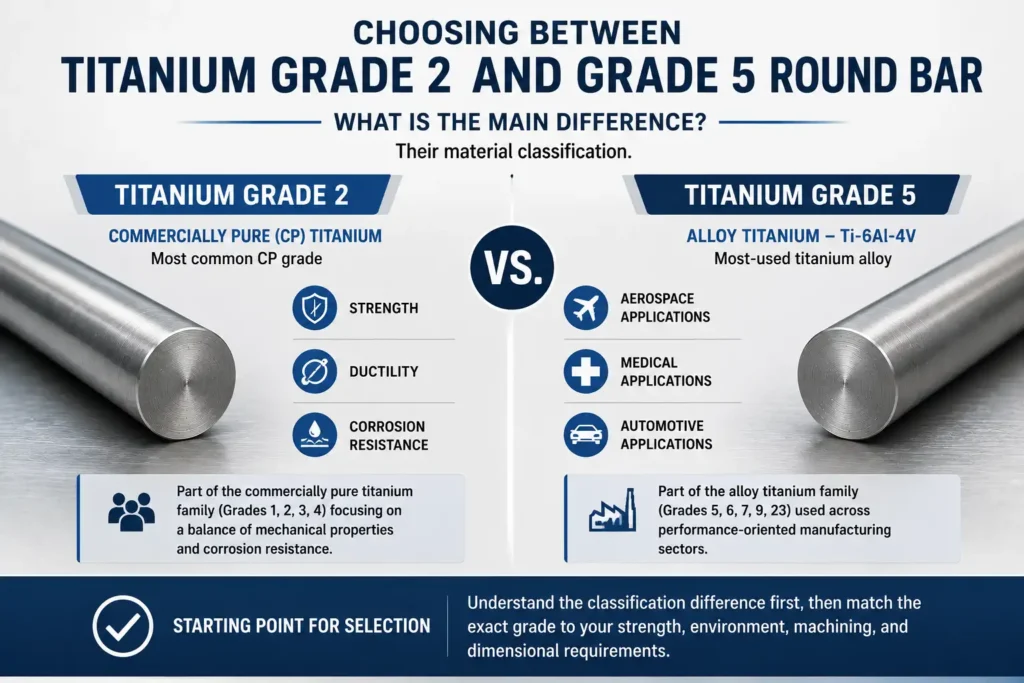
Grade 2 is a commercially pure titanium grade and is commonly used when a balanced combination of strength, ductility, and corrosion resistance is required. Grade 5 is Ti-6Al-4V, an alloy that provides higher strength along with corrosion resistance and good weldability. We consider Grade 5 for applications such as aerospace, medical, and automotive components when the project requirements support it.
When we review Grade 2
We review Grade 2 when the part needs a balanced combination of strength, ductility, and corrosion resistance rather than the higher-strength alloy position associated with Grade 5. For chemical-processing work, we ask about the fluid, temperature, cleaning, exposure, and component function before confirming the grade. Grade 2 can be a strong candidate for chemical-processing applications, but the exact process environment still controls the decision.
Grade 2 may also deserve review when forming or ductility is important. We do not assume that a general balance is sufficient for every vessel-related, piping-related, or machined component. The drawing and service details must define the final requirement.
When we review Grade 5
We review Grade 5 when higher strength is the leading requirement and corrosion resistance and good weldability also fit the project. Its combination of high strength, corrosion resistance, and good weldability makes Grade 5 a natural starting point for many aerospace components, but we still ask for the load, geometry, temperature, joining method, and inspection requirements.
For chemical-processing equipment, we do not automatically replace Grade 2 with Grade 5. We compare the required strength and corrosion behavior with the process conditions and ask for technical confirmation. The correct grade is the one that fits the complete application, not simply the grade with the higher strength description.
Chemical processing and aerospace create different priorities
Chemical-processing applications usually make the operating environment central. We ask what fluid contacts the part, whether exposure is continuous or intermittent, what cleaning method is used, and whether temperature changes the requirement. Aerospace applications often make strength, corrosion resistance, weldability, dimensional control, and documentation central. We use those questions to build one focused material decision.
Titanium also includes commercially pure Grades 1-4 and alloy grades such as 5, 6, 7, 9, and 23. We consider the broader titanium family when the application calls for a different combination of properties, but we do not use another grade’s properties or application as a substitute for the grade specified on your drawing.
Precision-ground titanium bar requirements
The grade is separate from the incoming bar specification. We state the nominal diameter, tolerance, straightness, surface finish, cut length, quantity, and any required condition. If the bar will become a machined aerospace or chemical-processing component, we relate each attribute to the required fit, turning allowance, assembly, and inspection plan.
Diameter and tolerance
We ask whether the requested diameter is incoming bar size or finished component size. We also ask whether fixed cut lengths are required before machining. A clear distinction keeps the quote aligned with the actual raw material requirement and avoids using a finished-part dimension as the bar size.
Straightness and finish
Straightness can affect workholding and alignment for long round components. Surface finish can affect later machining, sealing, contact, or assembly. We list both separately from diameter tolerance and ask your team to place the required limits on the drawing or RFQ.
Strength and weldability
If the project depends on strength or weldability, we ask you to state the exact requirement so we can confirm the available material condition. Grade 5 offers good weldability, but that general characteristic does not replace a project-specific joining procedure or quality plan.
What we include in the quote request
We provide the grade, diameter, tolerance, straightness, surface finish, cut length, quantity, part function, environment, load or strength requirement, joining method, and inspection needs. We also identify whether the part is for chemical processing, aerospace, or another approved use.
Use our Request a Quote path to submit the drawing and requirements. You can review the wider materials selection when your engineering team is comparing titanium with another material family.
Final decision
We review Grade 2 titanium round bar first when a balanced combination of strength, ductility, and corrosion resistance fits the application. We review Grade 5 titanium round bar first when higher strength, corrosion resistance, and good weldability lead, especially for aerospace work. For chemical processing, we confirm the actual exposure before approving either grade. The drawing, environment, dimensions, condition, and inspection requirements complete the decision.
FAQs
What is the main difference between Grades 2 and 5?
We compare Grade 2 as balanced CP titanium and Grade 5 as a higher-strength Ti-6Al-4V alloy with good weldability.
Which grade should you review for aerospace?
We review Grade 5 first when higher strength is a primary requirement because its high-strength Ti-6Al-4V composition makes it well suited for many aerospace applications.
Which grade should you review for chemical processing?
We review the environment first, then compare Grade 2’s balance with the exact corrosion and strength requirements.
Is Grade 5 always stronger for every design?
We do not approve a grade from a general description. We confirm the required condition and project-specific mechanical properties.
What bar specifications should you provide?
Send grade, diameter, tolerance, straightness, surface finish, cut length, quantity, and drawing requirements.
How do you request confirmation?
Send the application, environment, drawing, preferred grade, quantity, and inspection needs through Request a Quote.